
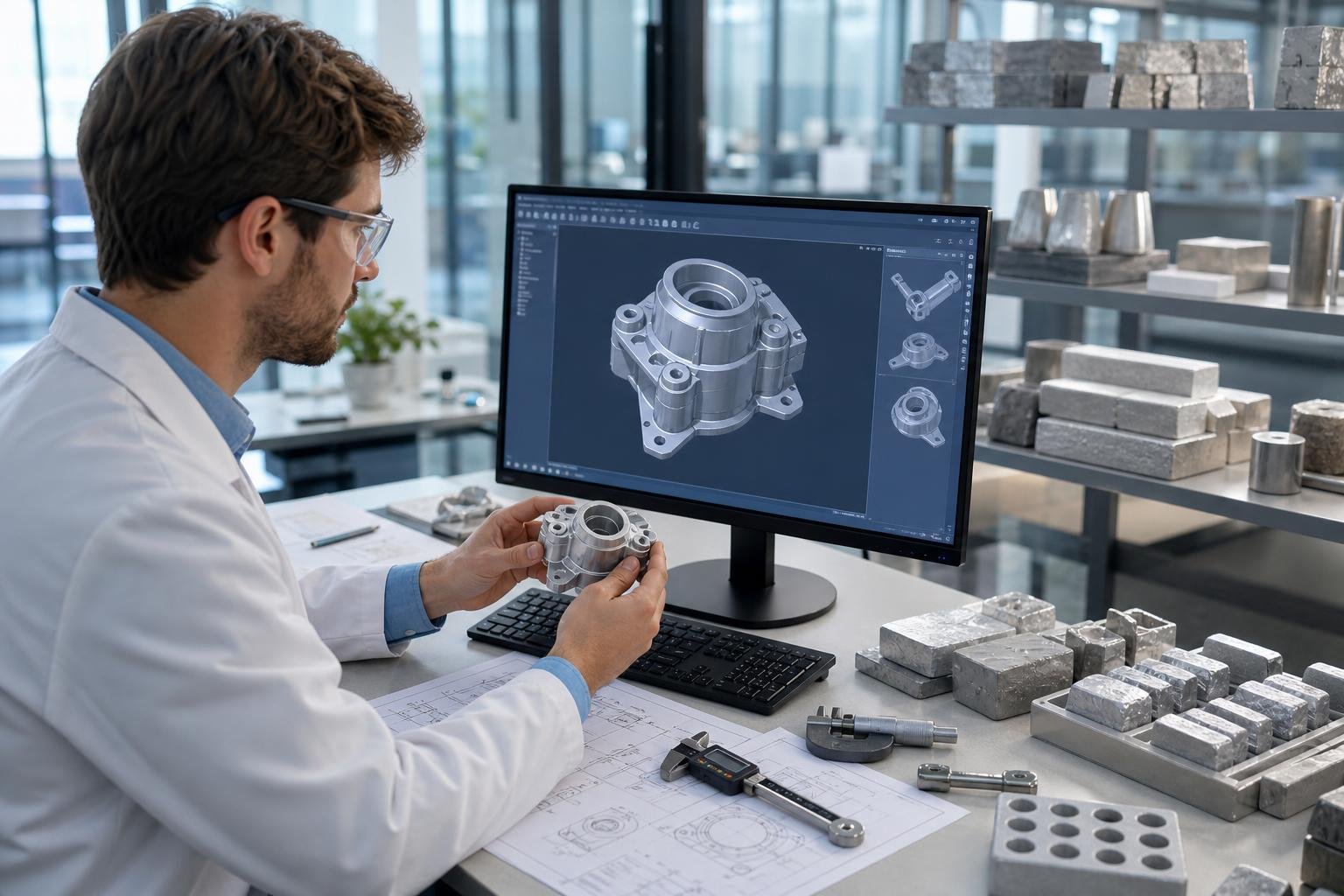
How to Design a Part for Zinc Die Casting: Expert Engineering Guide
Zinc die casting offers engineers and product buyers a proven method to produce complex metal parts with tight tolerances and excellent surface finish. To design a part for zinc die casting, you must consider wall thickness uniformity, draft angles, parting line placement, and material selection to achieve a manufacturable design that balances cost, quality, and performance. Understanding these fundamentals helps you avoid common defects and expensive redesigns during production.
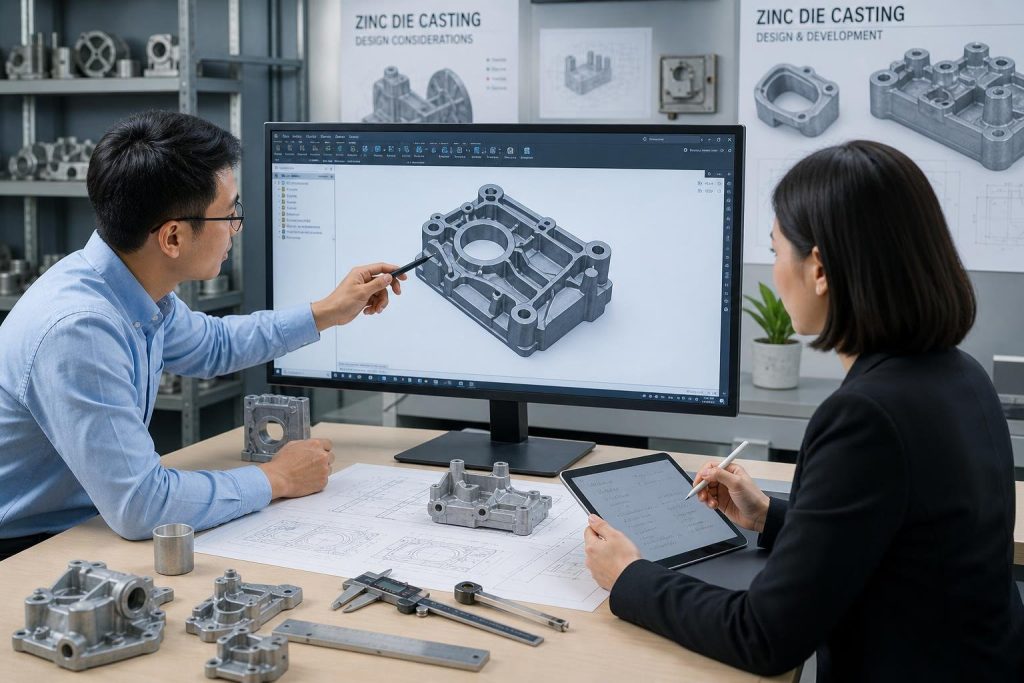
Your design choices directly impact tooling costs, cycle times, and part quality. Zinc alloys provide unique advantages for die casting, including lower melting temperatures and excellent dimensional stability. When you apply proper design principles from the start, you can create parts that are easier to produce, more reliable, and more cost-effective than alternatives.
This guide walks you through the essential considerations for designing zinc alloy die castings effectively. You’ll learn how to optimise geometry, select appropriate tolerances, plan for surface treatments, and work with manufacturers to ensure your parts meet specifications whilst keeping production efficient.
Key Takeaways
- Uniform wall thickness and proper draft angles are essential for achieving quality zinc die cast parts with minimal defects
- Parting line placement and gate design directly affect production costs, surface finish, and dimensional accuracy
- Working with zinc alloy properties and applying design for manufacturability principles reduces tooling expenses and speeds up production
Fundamentals of Zinc Die Casting
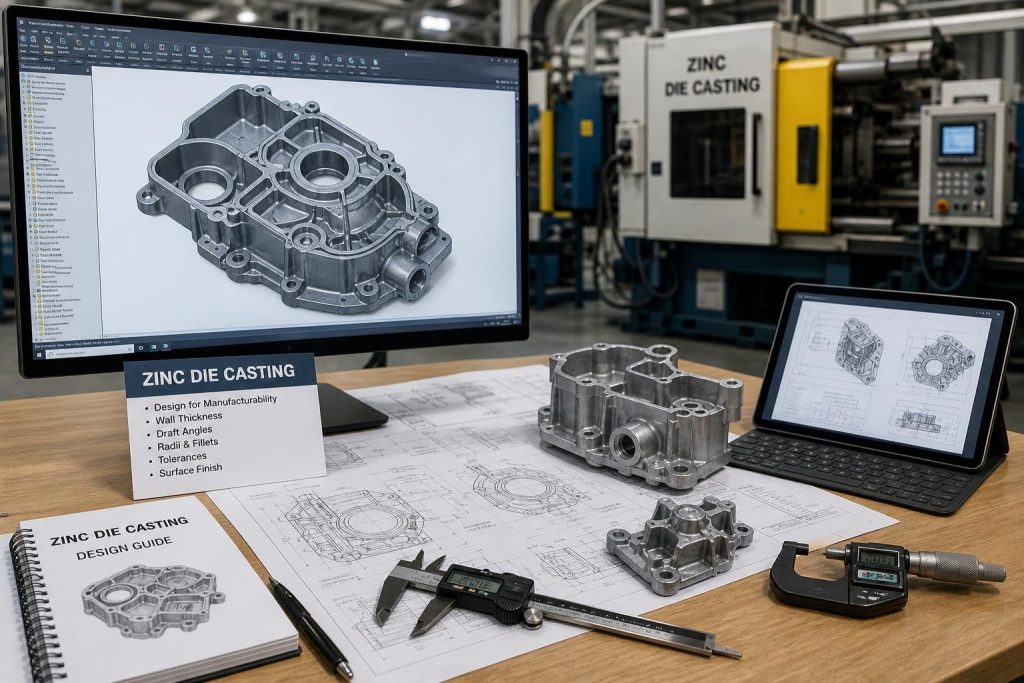
Zinc die casting injects molten zinc alloy into steel moulds under high pressure to create precise metal parts. The process uses either hot or cold chamber methods depending on the alloy, with hot chamber being the dominant approach for zinc due to its relatively low melting point of around 419°C.
Principles of the Die Casting Process
The zinc die casting process starts when molten zinc alloy enters a steel die cavity at pressures ranging from 10 to 175 MPa. The metal fills the mould rapidly, typically in milliseconds, allowing it to capture fine details and complex geometries before solidifying.
A die casting machine holds two die halves together during injection. One half remains stationary whilst the other moves to open and close the die. The parting line where these halves meet leaves a witness mark on finished castings even after trimming.
After the metal solidifies, the die opens and ejector pins push the casting out. The entire sequence happens quickly, enabling high production rates. Zinc’s high fluidity ensures complete filling of thin sections, whilst its low melting point reduces thermal stress on tooling compared to aluminium or magnesium alloys.
Hot Chamber vs Cold Chamber Methods
Hot chamber die casting keeps the injection mechanism submerged in molten metal. A piston or plunger forces the liquid zinc directly from the holding furnace into the die cavity. This method dominates zinc die casting because zinc alloys don’t attack the steel injection components at their melting temperature.
Cold chamber machines require ladling molten metal into a separate injection chamber before each shot. You’ll rarely use this method for zinc since the extra step slows production. Cold chamber suits metals with higher melting points that would damage submerged injection systems.
Hot chamber machines achieve faster cycle times because the metal stays molten and ready. The process also reduces oxidation since the metal spends less time exposed to air.
Production Cycle and Efficiency
A typical zinc die casting cycle takes 15 to 60 seconds from die close to part ejection. Smaller parts with simpler geometries cycle faster than large complex components. The die closes, metal injects in milliseconds, cooling takes 5 to 30 seconds, then the die opens and ejects the part.
Production efficiency improves when you design parts with uniform wall thickness and proper draft angles. Consistent sections cool predictably, reducing cycle time variability. Hot chamber machines can produce 300 to 500 shots per hour for small parts, making them highly productive.
Die temperature control affects both quality and speed. Maintaining stable temperatures prevents defects whilst allowing rapid solidification. Automated systems can run continuously with minimal supervision once optimised.
Applications in Industry
Zinc die castings appear throughout automotive systems including door handles, seat mechanisms, fuel system components, and decorative trim. The alloy’s strength-to-weight ratio and dimensional stability suit these applications well.
Consumer electronics rely on zinc for EMI/RFI shielding housings, connector bodies, and structural chassis components. The material’s excellent electrical conductivity and ability to hold tight tolerances make it suitable for these precision parts.
Industrial equipment uses zinc castings for pump housings, valve bodies, and metering device components. Plumbing fixtures, locks, and hand tools represent other common applications. The process delivers the precision and surface finish these products require whilst keeping manufacturing costs reasonable at medium to high volumes.
Material Selection and Zinc Alloy Properties

Selecting the right zinc alloy affects part strength, surface finish quality, production speed, and long-term durability. The four primary alloys—Zamak 3, Zamak 5, Zamak 7, and ZA-8—offer different combinations of castability, mechanical properties, and finishing behaviour.
Zamak Alloys Overview
Zamak alloys are zinc-based materials that contain aluminium, magnesium, and copper in varying amounts. These alloys run on hot-chamber die casting equipment due to their low melting temperature, which typically ranges from 380°C to 420°C.
Zamak 3 is the most widely used zinc alloy for general-purpose parts. It provides balanced strength, ductility, and dimensional stability. Zamak 5 adds copper content, which increases tensile strength and hardness but reduces ductility slightly.
Zamak 7 improves fluidity and polishability, making it suitable for thin-walled parts and premium cosmetic surfaces. ZA-8 is a zinc-aluminium alloy with higher aluminium content that delivers greater strength whilst remaining compatible with hot-chamber casting equipment.
Common Zamak alloy compositions:
| Alloy | Aluminium | Copper | Magnesium | Best For |
|---|---|---|---|---|
| Zamak 3 | 3.5–4.3% | Max 0.25% | 0.02–0.05% | Balanced general use |
| Zamak 5 | 3.5–4.3% | 0.75–1.25% | 0.03–0.08% | Higher strength needs |
| Zamak 7 | 3.5–4.3% | Max 0.10% | 0.005–0.020% | Thin walls and polishing |
| ZA-8 | 8.0–8.8% | 0.8–1.3% | 0.015–0.030% | Structural applications |
Mechanical and Physical Characteristics
Tensile strength varies across zinc alloys based on composition. Zamak 3 typically achieves 268 MPa tensile strength in as-cast condition. Zamak 5 reaches approximately 328 MPa due to its copper content.
ZA-8 provides the highest strength among hot-chamber alloys at around 374 MPa. This strength step makes ZA-8 useful for compact parts that experience repeated loads or require improved wear resistance.
Hardness follows a similar pattern. Zamak 5 registers 91 HB (Brinell hardness) compared to Zamak 3’s 82 HB. Higher hardness improves wear resistance in applications with repetitive contact or friction.
Ductility decreases as strength increases. Zamak 3 offers approximately 10% elongation, whilst Zamak 5 drops to around 7%. For parts with snap fits or assemblies requiring flex, the material selection must account for this trade-off between strength and ductility.
Fluidity and Material Behaviour
The low melting temperature of zinc alloys enables excellent mould filling characteristics. Zamak 7 exhibits the best fluidity amongst the standard alloys, allowing you to cast walls as thin as 0.5 mm in small components.
Good fluidity supports complex geometries with fine details, tight corners, and extended flow paths. Parts with thin ribs, small bosses, or intricate surface textures benefit from alloys optimised for flow behaviour.
Hot-chamber processing keeps the metal delivery system submerged in molten zinc. This design reduces cycle times compared to cold-chamber methods and maintains consistent metal temperature throughout production runs.
All four common zinc alloys work with hot-chamber equipment. This compatibility allows you to select material based on mechanical requirements rather than process limitations.
Corrosion Resistance and Durability
Zinc alloys form a protective oxide layer that provides moderate corrosion resistance in indoor environments. For outdoor or harsh chemical exposure, surface treatments become necessary.
Electroplating, powder coating, and chromate conversion coatings enhance corrosion protection significantly. Zamak 7 accepts decorative chrome plating particularly well due to its refined grain structure and superior polishability.
Sustained exposure to temperatures above 95°C can affect dimensional stability and mechanical properties over time. If your application involves elevated temperatures, compare zinc against aluminium die casting alternatives.
Material selection should account for the complete duty cycle. Consider ambient temperature, contact with fluids, UV exposure, and mechanical loading patterns when choosing between alloys.
Wall Thickness and Section Uniformity
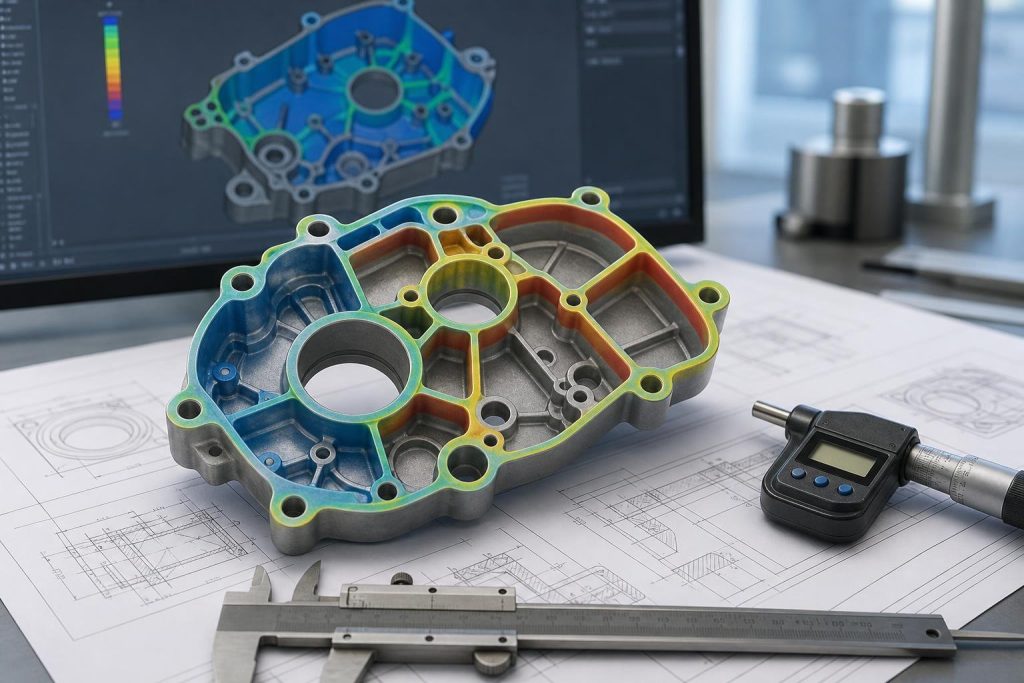
Wall thickness directly affects metal flow, cooling rates, and the structural integrity of your zinc die cast part. Keeping sections uniform prevents defects and reduces production costs.
Guidelines for Minimum and Maximum Thickness
The recommended wall thickness for zinc die casting typically ranges from 1.0 mm to 3.0 mm, with 1.2 mm to 2.5 mm being most practical for many designs. Your minimum wall thickness depends on how far the section sits from the ingate.
For sections less than 50 mm from the ingate, you can achieve walls below 0.5 mm. At distances around 200 mm, aim for at least 2 mm thickness to ensure proper metal flow and fluidity.
Very few zinc die cast parts use wall sections above 6 mm. Thicker walls don’t strengthen your part proportionally and actually waste material whilst increasing cycle times.
Uniform Walls for Flow and Solidification
Uniform wall thickness is crucial for controlling how molten zinc flows and solidifies in the mould. When wall thickness varies too much, you risk shrinkage porosity in thicker areas.
Use the inscribed sphere technique to check your design. Imagine fitting spheres into different sections of your part. If sphere diameters differ by more than 3:1, expect shrinkage porosity. Ratios exceeding 6:1 will cause severe defects and significantly reduce strength in those areas.
Design transitions between different thicknesses gradually using fillets and blends. This helps maintain smooth metal flow and prevents casting defects during solidification.
Thin Walls and Their Advantages
Thin walls are proportionately stronger than thick ones in zinc die casting. Designs with fairly even thin wall sections use less material and solidify faster, which reduces your production costs.
Thinner sections also minimise the risk of shrinkage-related defects. As molten zinc cools, uniform thin walls contract more predictably than thick sections.
If your part needs additional strength, add ribs rather than increasing overall wall thickness. Ribs provide stiffness without creating thick sections that slow solidification and promote porosity.
Optimising Die Casting Geometry
Proper geometric features directly affect part quality, production speed, and manufacturing cost. Correct draft angles prevent sticking during ejection, while well-designed fillets and ribs strengthen parts without adding unnecessary material.
Draft Angles and Ejection
Draft angles allow your casting to release cleanly from the die without sticking or damage. You need a minimum of 1° on internal surfaces and 0.5° on external surfaces for most zinc die castings.
Round holes require only 0.1° of draft, making them easier to form than other internal features. Shallow ribs need more taper, typically 5-10°, though ribs aligned with shrinkage direction can use smaller tapers.
In some cases, you can achieve 0° draft on critical features when working with an experienced die caster. This eliminates post-machining but increases tool costs. All zero-draft features must form from the moving die half, and you need positive square ejection to prevent the casting from sticking during die opening.
Higher draft angles reduce ejection force and extend die life. Your part geometry should allow the casting to move back with the moving die half when the die opens.
Fillets, Radii, and Corners
Sharp corners create stress concentrations and weaken your casting. You should use a minimum fillet radius of 0.4mm to replace sharp corners, though larger radii work better when your design allows.
Inside edges perform best with fillets of at least 1.6mm radius. A slight radius on outside corners reduces die cost and improves finish durability. Buffing or polishing can cut through finishes at sharp outside edges, whilst organic coatings thin out and provide inadequate protection along sharp edges.
Recommended Fillet Radii:
- Minimum (any corner): 0.4mm
- Inside edges: 1.6mm minimum
- Outside edges: 0.8mm or greater
Blended transitions between walls of different thicknesses prevent porosity and improve metal flow. You should taper thick sections gradually into thin sections rather than creating abrupt changes.
Ribs, Bosses, and Reinforcements
Ribs strengthen your casting without increasing overall wall thickness. They should be rounded, well-blended, and connect adjacent sections to provide mutual support whilst assisting die filling.
Shallow, rounded, well-distributed ribs work best because they cause less distortion after ejection. You should avoid thick sections where ribs intersect or shrinkage porosity may occur at these points.
Bosses provide attachment points and mounting locations. Design them with adequate draft and avoid making them too thick compared to surrounding walls. Use the inscribed sphere technique to check thickness ratios—if imaginary spheres fitted into different sections have diameter ratios exceeding 3:1, you risk shrinkage porosity in thicker areas.
Thin flat plates gain significant strength from added ribs. This approach uses less material than simply thickening the entire plate whilst improving die filling behaviour and reducing cycle time.
Parting Lines, Gate, and Venting Design
The placement of your parting line affects die strength, flash formation, and trimming costs, whilst proper gate design and venting prevent defects like porosity and trapped gas.
Parting Line Placement Strategies
Your parting line represents where the die halves meet. It must typically sit at the maximum diameter or section of your casting. Die costs and flash removal costs are lowest when the parting line lies in one flat plane at right angles to die motion.
Avoid vertical parting lines that run parallel to the direction of die opening. This design choice gives you stronger die construction, less flash formation, and simpler trimming. You should position the parting line to minimise visible witness marks on aesthetic surfaces. Creating a bead at the parting line often makes these marks less noticeable whilst simplifying flash removal.
Tight tolerances are difficult to achieve on parting line dimensions. Complex parting lines are possible and frequently used, but they increase both die cost and maintenance requirements. When designing your part, consider how adequate gate area can be provided at the parting line without creating thick gates that leave heavy witness marks.
Gating for Optimal Metal Flow
Your gate design controls where molten metal enters the die cavity. The position and length available for the gate directly affects surface finish and porosity levels. If metal cannot flow directly into all parts of your casting, you will struggle to achieve good surface quality.
Adequate gate area is essential for proper die filling. When gate length is restricted, the gate must be thicker to allow sufficient metal flow. This creates trimming problems and heavy witness marks on your finished part. You can often overcome these issues by changing your component geometry at the initial design stage.
Your gating should promote smooth, turbulent-free metal flow. Generally, the more uniform your wall thickness, the easier this becomes. Metal should fill the die quickly and smoothly to avoid surface imperfections.
Effective Venting to Minimise Defects
Proper venting allows air and gases to escape as molten metal fills your die cavity. Without adequate venting, trapped gas creates porosity, surface blemishes, and incomplete filling. These defects compromise both the appearance and structural integrity of your casting.
Vents are typically placed at the last points to fill in your die cavity. They must be large enough to allow gas escape but small enough to prevent metal from flowing through. You should work closely with your die caster to identify where venting is needed based on your part geometry and metal flow patterns.
Process control during production helps identify venting problems early. If you notice increased porosity or surface defects in specific areas, insufficient venting may be the cause.
Surface Finish and Post-Casting Treatments
Zinc die castings benefit from various surface treatments that enhance appearance, durability, and corrosion resistance. The right combination of surface texture and finishing process depends on your part’s functional requirements and aesthetic goals.
Surface Texture and Aesthetics
The surface finish of zinc die-cast components significantly affects visual appeal and functionality. As-cast surfaces typically show a smooth finish with minor imperfections from the die surface.
You can specify textured surfaces directly in the die design. This approach creates consistent patterns like graining, stippling, or geometric textures without additional processing. Textured surfaces hide minor imperfections and reduce visible fingerprints on consumer products.
For refined aesthetics, you’ll need post-casting treatments. Shot blasting removes flash and creates uniform matte surfaces. Vibratory finishing smooths edges and produces consistent surface texture across all parts. These mechanical processes prepare your castings for decorative finishes.
Common Surface Preparation Methods:
- Shot blasting – removes die release agents and oxidation
- Vibratory tumbling – deburrs edges and refines surface texture
- Sanding or grinding – targets specific areas requiring smoothness
Polishing and Plating Options
Electroplating transforms zinc castings with decorative and protective metallic layers. Chrome plating provides a mirror-like finish with over 1,000 hours of salt spray resistance, making it ideal for exterior automotive components despite higher labour costs.
Bright nickel creates a reflective surface but remains brittle. You shouldn’t use it on parts requiring bending after plating. Electroless nickel offers uniform coating thickness through chemical immersion rather than electrical current, delivering excellent wear properties.
Popular Plating Finishes:
| Finish Type | Key Benefits | Best Applications |
|---|---|---|
| Chrome | Mirror finish, excellent corrosion resistance | Automotive trim, decorative hardware |
| Bright nickel | Reflective appearance | Decorative components (non-flexing) |
| Electroless nickel | Uniform thickness, wear resistant | Technical parts requiring precision |
| Cobalt tin | Chrome-like appearance, lower cost | Consumer electronics, appliances |
Silver plating provides the highest electrical conductivity but tarnishes when exposed to atmosphere. Gold plating resists oxidation and maintains solderability, justifying its cost in electronic connectors.
Powder Coating and Painting
Powder coating ranks among the most popular finishes for zinc die castings. This process applies dry powder electrostatically before curing at high temperatures, creating a durable, scratch-resistant surface. You’ll find powder coating available in numerous colours, gloss levels, and textures.
Your die casting process must maintain tight control because powder coating’s high curing temperatures can reveal porosity or dimensional issues. Parts with excellent as-cast quality produce superior powder-coated finishes.
Polyurethane painting offers durability for exterior applications. This wet process creates slightly thicker coatings than powder, so you’ll need to account for mating surfaces in your design. Water-borne paints provide environmentally friendly alternatives with comparable durability once cured.
E-coat delivers outstanding coverage through electrical deposition. You can use it alone for functional parts or as an undercoat beneath powder coating for enhanced protection. The racking and un-racking process adds cost, but the uniform coverage justifies this expense for complex geometries.
Coating Comparison:
- Powder coating – toughest finish, best scratch resistance, limited to heat-stable parts
- Polyurethane paint – excellent for outdoor exposure, slightly thicker application
- E-coat – superior coverage in recesses, ideal basecoat for multi-layer systems
Design for Manufacturability (DFM) in Zinc Die Casting
A thorough DFM approach reduces tooling cost, extends tool life, and improves production efficiency by identifying potential issues before manufacturing begins. Proper mould design and planning for secondary operations ensure your parts meet specifications without excessive machining or rework.
DFM Review and Optimisation
DFM review examines your part design to identify features that could complicate manufacturing or increase costs. Engineers analyse wall thickness ratios, draft angles, parting line placement, and gate locations to ensure smooth metal flow and consistent part quality.
A comprehensive DFM review addresses potential shrinkage porosity by checking section ratios using the inscribed sphere technique. If sphere diameters differ by more than 3:1, you risk porosity in thicker areas. Ratios exceeding 6:1 cause severe defects that reduce strength.
Your DFM team should evaluate how your part will eject from the mould. Features with inadequate draft angles require costly secondary machining. Maintaining uniform wall thickness and using proper fillets at intersections improve manufacturability whilst reducing material usage.
The review process typically involves adjusting dimensions, relocating features to single die members, and simplifying parting lines. These changes can dramatically reduce both initial tooling cost and ongoing maintenance expenses.
Mould Design and Tooling Life
Your mould design directly impacts tool life and production efficiency. Parting lines on flat planes are easier to maintain during high-volume production and experience less flash formation compared to complex parting geometries.
Positioning the parting line at the maximum diameter or section of your casting minimises die costs. Avoiding vertical parting lines—those running parallel to die movement—creates stronger die construction and reduces maintenance frequency.
Tool life extends when you design features formed by single die members rather than across parting lines. Cross-parting dimensions suffer from wear between mating die surfaces, requiring more frequent adjustments to maintain tolerances.
| Design Feature | Impact on Tool Life |
|---|---|
| Flat parting plane | Reduced maintenance, less flash |
| Single-member features | Minimal wear, consistent tolerances |
| Proper draft angles | Easier ejection, less die damage |
Adequate gate area prevents excessive pressure that accelerates die erosion. If gate length is restricted, the gate becomes thicker, creating trimming problems and heavy witness marks whilst reducing tooling life.
CNC Machining and Secondary Operations
Secondary operations like CNC machining, trimming, and precision machining add cost to each part. Planning for these processes during design helps minimise their impact on production efficiency.
Trimming removes flash from the parting line and gates. You can reduce trimming complexity by designing simple parting line geometry and adequate draft angles. Features that require zero draft typically need precision machining to achieve final dimensions.
Specify tight tolerances only where necessary for function. Best achievable tolerances of 0.1% require statistical process control and inspection with precise measurements. Normal minimum tolerances of 0.2% eliminate the need for extensive quality control whilst maintaining excellent precision.
Post-casting CNC machining is sometimes more economical than building complex features into the mould. Threaded holes, precise bores, and critical mounting surfaces often benefit from machining rather than attempting to cast them to final dimensions.
Your inspection strategy should account for high-volume production requirements. Features formed by single die members maintain tighter tolerances with less inspection effort compared to cross-parting dimensions.
Achieving Dimensional Accuracy and Precision
Zinc die casting delivers exceptional dimensional accuracy through controlled processes and proper design considerations. Understanding tolerance ranges and stability factors helps you specify requirements that balance precision with cost-effectiveness.
Dimensional Tolerances
The best achievable linear tolerances in zinc die casting reach a tolerance band within 0.1% of the dimension at 8 standard deviations confidence level. This precision requires favourable component geometry and close collaboration with your die caster.
Normal minimum tolerances operate at 0.2% of dimension. These are easier to maintain and don’t require statistical process control in most cases. For dimensions below 150mm, this tolerance exceeds ISO8062 DCG3 specifications for zinc alloys.
Standard tolerances represent what you can expect at first die trial without adjustments. The tolerance band equals 0.2% of nominal dimension plus 0.1mm. This approach avoids costs associated with modifying hardened steel dies.
Key factors affecting tolerances:
- Dimensions formed by single die members achieve tighter tolerances than cross-parting line dimensions
- Cross-parting line tolerances require more frequent maintenance due to wear between mating surfaces
- Specifying tighter tolerances than necessary increases die maintenance and quality control costs
You should only specify precision tolerances when they prevent machining operations or ensure critical functionality.
Flatness, Stability, and Repeatability
Flat surfaces present challenges in precision die casting. Completely flat decorative surfaces highlight any small imperfections and increase production costs. Crowning the surface slightly or adding texture improves both appearance and dimensional stability.
Achieving dimensional repeatability depends on consistent shrinkage patterns after ejection from the die. Components with uniform wall thickness and proper section ratios maintain better dimensional stability across production runs.
Wall section ratios significantly impact stability. Use the inscribed sphere technique to check your design: compare imaginary spheres fitted into different sections. When sphere diameters differ by more than 3:1, shrinkage porosity may occur. Ratios exceeding 6:1 cause severe effects and reduce strength.
Thin, evenly distributed walls provide better dimensional repeatability than thick sections. They shrink more predictably and reduce internal stresses that cause distortion.
Dealing with Tight Tolerances
When your application requires tight tolerances, you must work closely with a die caster experienced in precision castings. Some features can achieve 0° draft angles with proper die design, though this increases costs.
Zero-draft features must form from the moving die half with positive square ejection to prevent sticking. This eliminates subsequent machining whilst maintaining dimensional precision.
Adjust your expectations based on feature location. Exacting tolerances are very difficult if not impossible to achieve on parting line dimensions. Position critical dimensions within single die members whenever possible.
Initial die trials may require dimensional adjustments even with precision specifications. Budget time and cost for potential die modifications when targeting best achievable tolerances. Statistical quality control becomes necessary to maintain conformance at the tightest tolerance levels.
Addressing Common Defects and Quality Control
Quality zinc die castings require understanding potential defects and implementing prevention strategies during design and production. Proper wall thickness, gating systems, and process controls minimise porosity, flash, and dimensional issues while meeting ISO 9001:2015 standards.
Porosity and Void Prevention
Porosity appears as small holes or voids within the casting structure. It weakens mechanical properties and creates leaks in pressure-tight components.
Gas porosity forms when air becomes trapped during metal injection. You can reduce this by optimising gate placement and using proper venting in your die design. Shrinkage porosity occurs when molten metal solidifies unevenly, leaving cavities in thick sections.
Design your part with uniform wall thickness between 0.75mm and 3mm. Avoid thick bosses or ribs that cool slower than surrounding areas. When thick sections are necessary, use coring to maintain consistent wall thickness throughout.
Understanding porosity causes helps you specify appropriate design features. For critical applications requiring zero porosity, specify vacuum impregnation as a secondary process. This seals microscopic voids with resin, making parts pressure-tight and improving mechanical strength.
Sink Marks, Flash, and Trimming
Sink marks are surface depressions that form over thick sections as the metal shrinks during cooling. They create visible defects on cosmetic surfaces and affect dimensional accuracy.
Position gates away from visible surfaces when possible. Add ribs to support large flat areas rather than increasing wall thickness. Keep boss diameters under three times the nominal wall thickness.
Flash is excess material that escapes between die halves during casting. It forms thin fins along parting lines that require removal. Insufficient machine tonnage, worn dies, or misaligned tooling cause flash formation.
Your design should account for flash removal by avoiding critical dimensions on parting lines. Specify appropriate tolerances that accommodate trimming operations. Regular die maintenance and proper clamping force prevent excessive flash during production runs.
Cracks, Cold Shut, and Shrinkage
Cracks appear as fractures in the casting caused by thermal stress or mechanical strain. Sharp internal corners create stress concentrations where cracks initiate. Use generous radii (minimum 0.5mm) on all internal corners and transitions.
Cold shut defects occur when two metal flow fronts meet but don’t fuse properly. This creates a visible line or weak seam in the casting. Poor gating design, insufficient metal temperature, or slow injection speeds cause cold shuts.
Position gates to ensure smooth metal flow throughout the cavity. Avoid designs requiring metal to flow around obstacles and rejoin. Preventing common casting defects requires collaboration between design engineers and die casters during the quotation phase.
Shrinkage creates dimensional variations as zinc contracts approximately 0.6% during solidification. Calculate shrinkage allowances into your die design to achieve final dimensions within tolerance.
Inspection Standards and ISO 9001
ISO 9001:2015 provides the framework for quality management systems in die casting operations. Manufacturers certified to this standard demonstrate consistent process control and continuous improvement capabilities.
Request quality documentation including dimensional reports, material certifications, and process parameter records. Specify inspection requirements based on your application’s criticality and industry standards.
NADCA (North American Die Casting Association) publishes product specification standards for acceptable defect levels. These standards classify parts into categories based on function and appearance requirements:
- Class A: Visible cosmetic surfaces requiring highest quality
- Class B: Semi-visible surfaces with moderate requirements
- Class C: Internal or non-visible surfaces with functional requirements only
Define acceptable quality levels (AQL) for dimensional tolerances, surface finish, and visual defects in your purchase specifications. Coordinate inspection methods including coordinate measuring machines (CMM), visual examination, and non-destructive testing where appropriate for quality assurance.
Secondary Machining and Assembly Features
Zinc die casting can produce near-net-shape parts, but certain features require secondary operations to meet precise specifications. Understanding which features can be cast directly and which need machining helps you balance cost against functionality.
Cored and Tapped Holes
Cored holes are formed directly in the die during casting. You can achieve through holes up to 12 times their diameter and blind holes up to 10 times their diameter for holes larger than 10mm. For a 5mm hole, you’re limited to 30mm depth for blind holes and 47mm for through holes.
Round holes require minimal draft angles of just 0.1°, making them highly accurate as-cast. However, holes smaller than 3mm diameter are generally impractical to core and should be drilled after casting.
Tapped holes always require secondary machining. The die casting process cannot produce threads directly in holes due to the mechanics of ejecting parts from the die. You should design cored holes with adequate wall thickness around them—typically 1.5 times the hole diameter—to ensure structural integrity during tapping operations. When designing for secondary CNC machining, specify which holes need tapping and their thread specifications clearly on your drawings.
Drilling and Milling
Drilling becomes necessary when hole diameters are too small to core reliably or when you need extremely tight tolerances. Zinc alloys machine easily, which keeps secondary drilling costs low compared to other metals.
Milling is required when you need flat surfaces with tolerances tighter than ±0.05mm or when mounting faces must be perfectly perpendicular to other features. Die cast surfaces typically have slight texture or minor imperfections that make them unsuitable for sealing surfaces or precision mounting points.
You can minimise milling costs by limiting machined areas to only critical surfaces. Design the part specifically for die casting by incorporating locating features and datum points that simplify fixturing during machining operations.
Integrating Inserts and Threads
Cast-in inserts slow production because operators must place them manually before each shot. This increases cycle time and labour costs significantly. Pressing inserts after casting is nearly always more economical.
When you must use cast-in inserts, design them with knurling or other mechanical features that prevent rotation under load. The insert should have adequate zinc alloy surrounding it—at least 1.5mm on all sides—to prevent cracking during cooling.
External threads can be cast directly onto posts or bosses, though they require draft angles that make them slightly tapered. For critical applications requiring perfect thread engagement, you’ll need secondary machining to true up the threads after casting.
Frequently Asked Questions
Engineers and buyers working with zinc die casting often need specific guidance on draft angles, wall thickness limits, and defect prevention. Understanding these technical details helps you make informed design decisions that balance performance with manufacturing cost.
What draft angles and radii are typically recommended for zinc die cast components?
The minimum draft angle requirement is 1° for internal surfaces and 0.5° for external surfaces. Round holes need only 0.1° of draft to release properly from the die.
Shallow ribs require more taper, typically 5-10°. However, ribs aligned with the direction of shrinkage, such as wheel spokes, can accept smaller tapers without causing ejection problems.
You can achieve 0° draft on critical features in some cases, but this requires working with a die caster experienced in producing such features. The casting must be formed from the moving die half, and the design must include positive square ejection to prevent sticking.
Sharp corners create weak points in your casting. You should use a minimum fillet radius of 0.4mm at all corners, though larger radii are better when space allows.
Inside edges typically use fillets with a minimum radius of 1.6mm. A slight radius on outside corners reduces die cost and helps any subsequent finish last longer, as buffing and polishing can cut through finishes at sharp edges.
What wall thicknesses and tolerances are achievable in zinc die casting, and how do they affect cost?
Thin wall sections are proportionally stronger than thick ones and use less material. This helps keep production costs down and speeds up cycle times.
The minimum practical wall thickness depends on the distance from the ingate. For distances under 50mm, you can achieve walls less than 0.5mm thick. At distances around 200mm, the minimum increases to about 2mm.
There is no critical upper limit to wall thickness, but few parts use wall sections above 6mm. Maintaining fairly constant section thickness throughout your design produces the best results.
You can check for problems using the inscribed sphere technique. Compare the sizes of imaginary spheres that fit into different sections of your part. If the sphere diameters differ by more than 3:1, shrinkage porosity may occur in thicker areas. Ratios exceeding 6:1 will cause severe porosity that significantly reduces strength.
The best achievable linear tolerance is within 0.1% of the dimension at the 8 standard deviations confidence level. This precision requires favourable component geometry that allows consistent shrinkage without distortion.
Normal minimum linear tolerances sit at 0.2% of the dimension. These tolerances are much easier to maintain for dimensions formed by one die member rather than across the parting line.
Standard tolerances equal 0.2% of the nominal dimension plus 0.1mm. This is the closest tolerance you can expect at first die trial, avoiding the cost and time delays of adjusting hardened steel dies.
Tighter tolerances increase die maintenance and quality control costs. You should only specify the precision your part actually needs to function properly.
How should ribs, bosses and undercuts be designed to minimise porosity and distortion in zinc die castings?
Ribs strengthen your casting without increasing overall wall thickness. They should be rounded and blended, and arranged to join adjacent sections where possible for mutual strengthening.
Thin flat plates benefit from shallow, rounded, well-distributed ribs. This pattern strengthens the part and assists die filling whilst being less likely to cause distortion after ejection.
You must avoid thick sections at rib intersections. These create hot spots where shrinkage porosity concentrates and weakens the casting.
Bosses and mounting posts need careful attention to section ratios. The junction between a boss and the main wall should transition smoothly with generous fillets to avoid creating trapped thick sections.
Undercuts prevent the casting from releasing from the die when it opens. They require slides, lifters, or other moving die members to form the feature.
Each additional moving die member increases tooling cost and maintenance requirements. You should design parts to minimise or eliminate undercuts whenever possible.
When undercuts are necessary, position them to allow simple slide motion perpendicular to the die opening direction. Complex angles or multiple undercuts in different directions significantly increase die complexity and cost.
Which gating, runner and venting considerations most influence fill quality and surface finish in zinc die cast parts?
The parting line position determines where metal can enter the die cavity. You should consider available gate location and length during initial design to ensure metal flows directly into all parts of the casting.
Adequate gate area is essential for proper filling. If gate length is restricted, the gate must be thicker, which causes trimming problems and leaves a heavy witness mark on your part.
Component design should allow metal to fill the die smoothly without turbulence. Turbulent flow causes surface imperfections that reduce quality.
Generally, the more uniform your wall thickness, the easier it is to achieve smooth filling. Sudden changes in section create flow problems and air entrapment.
The position where molten metal enters the die cavity proper is called the ingate. The distance from the ingate affects minimum achievable wall thickness throughout your part.
Venting allows trapped air to escape as metal fills the cavity. Inadequate venting causes gas porosity and incomplete filling in areas far from the gate.
Design changes to component geometry can often overcome gating problems identified during the initial design stage. This prevents costly modifications after tooling is complete.
What common zinc die casting defects should engineers design out, and how can they be prevented through DFM?
Porosity is the most common defect in zinc die castings. It occurs in two forms: gas porosity from trapped air and shrinkage porosity from thick sections cooling unevenly.
You prevent gas porosity through proper venting design and smooth metal flow without turbulence. Shrinkage porosity requires maintaining proper section ratios throughout your part.
Flash forms at the parting line where die halves meet. Complex parting lines increase flash formation and make trimming more difficult and expensive.
You should arrange the parting line in one flat plane perpendicular to die motion whenever possible. This minimises die costs and flash removal costs whilst making it easier to maintain flash-free production.
Distortion occurs when uneven cooling causes internal stresses. Parts


